
Table of Contents
As the European Union’s Carbon Border Adjustment Mechanism (CBAM) already transitioned on 1st January 2026, from its reporting phase to a definitive financial regime. Global exporters face a steep escalation in compliance costs. This mechanism serves as a "slow start" dial, financial obligations will phase in progressively as the EU Emissions Trading System (ETS) free allowances are phased out, requiring importers to purchase certificates that reflect the carbon embedded in their products.
In our previous series, we analyzed the role of actual versus default emission factors. For this analysis, we utilize our CBAM cost Dashboard to project the financial liability for exporters across the global through 2034, specifically focusing on the impact of EU Default Values. In this article, we have compared several product and sector across the nations of their CBAM export cost.
The Cost of Non-Compliance: Actual vs. Default Values
To define financial liability, one must understand product-embedded emissions. The EU has established default emission values for specific CN Codes. During the definitive phase, if a supplier fails to provide third-party verified data on actual emissions, importers must rely on EU default values. These default values are intentionally punitive, set at the higher end of emission intensities. Relying on them significantly increases your business's CBAM cost exposure compared to reporting verified actual data.
Calculation Methodology and Assumptions
Our projections are based on the following CBAM cost formula:
CBAM Cost (€/t) = ([Direct EF (tCO2/t) - (Benchmark (tCO2/t) × Phase in Rate)] * EUA Price (€/tCO2)) - Carbon price paid overseas (€/t)
Total CBAM Cost (€) = Volume (tonnes) × CBAM Cost (€/t)
The projected financial liabilities are based on a standard export volume of 100 tons per product, with the CBAM phase-in rate escalating from 2.5% in 2026 to 100% by 2034 in accordance with EU regulations. The calculation assumes a rising EU ETS (EUA) price, starting at €85 in 2026 and increasing by €5 annually until it stabilizes at €100 in 2029. Furthermore, as other countries are currently in the development phase of its own domestic carbon market, the "carbon price paid overseas" is factored at zero, meaning no domestic offsets are currently applied to reduce the total EU liability.
Iron and Steel: The Heavyweight Burden
Our analysis of the Iron and Steel sector reveals it as the most deeply exposed, with wide variations based on product complexity. For 100 tons of basic pig iron, costs are projected to start at €13,627 in 2026 and more than double to €32,890 by 2034. High-value products face an even harsher reality, like 100 tons of stainless steel ingots will see liabilities jump from €49,295 to €84,890, while high-speed steel bars will scale from €54,887 to a staggering €94,900 over the same period. This is nightmare for the Indian exporters. Even when we compare the Financial liability across the countries we found that India is top among all, this further leads to EU importers insecure and there might be chance that they can shift their supply chain to other countries low cost and low emission countries.
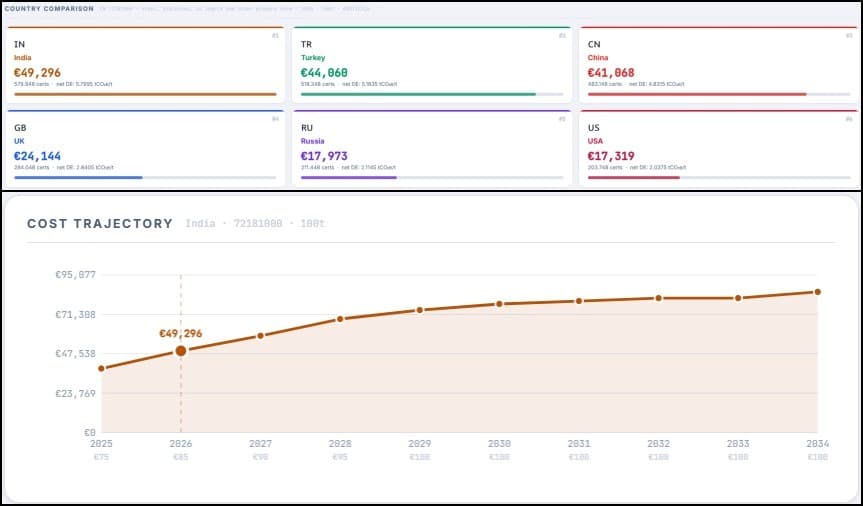
Source: CBAM Cost calculator (Regilient)
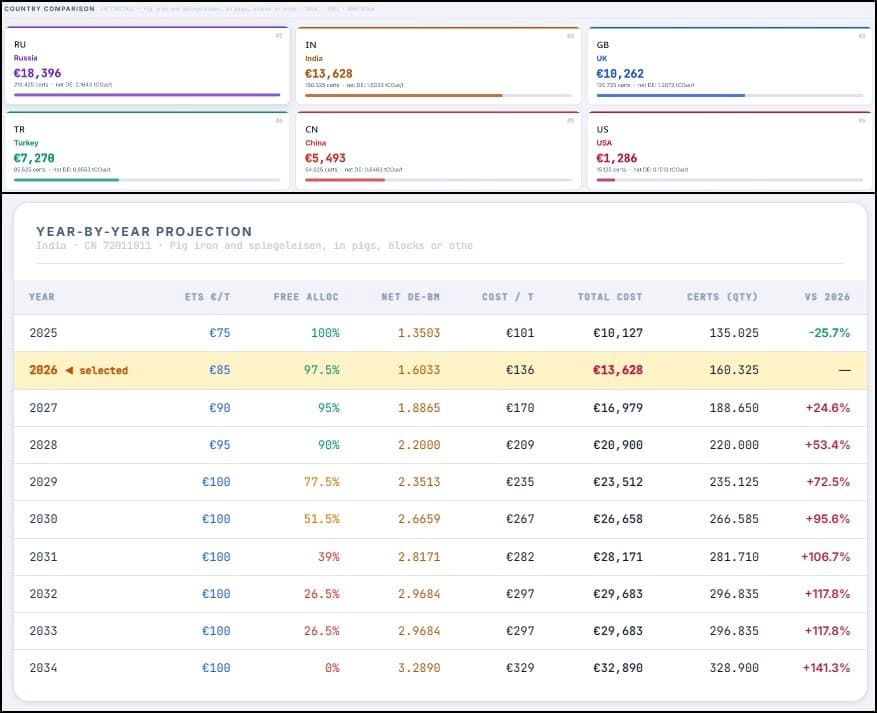
Source: CBAM Cost calculator (Regilient)
Aluminum and Hydrogen: A Steep Upward Cost Curve
The Aluminum and Hydrogen sectors will experience some of the sharpest absolute and relative cost increases due to high embedded energy intensities. Electricity-intensive smelting processes result in some of the sharpest relative cost increases. Processed Aluminium (Plates/Sheets) that is Value-added products incur higher baselines, rising from €26,272 in 2026 to €53,638 by 2034. Unwrought aluminum costs for 100 tons will skyrocket fourfold from €5,691 in 2026 to €24,310 by 2034. Hydrogen, however, represents the highest cost burden of all covered sectors; with a starting liability of €89,005 per 100 tons in 2026, it is projected to peak at €182,390 by 2034, underscoring the EU’s aggressive push for a transition to green hydrogen.
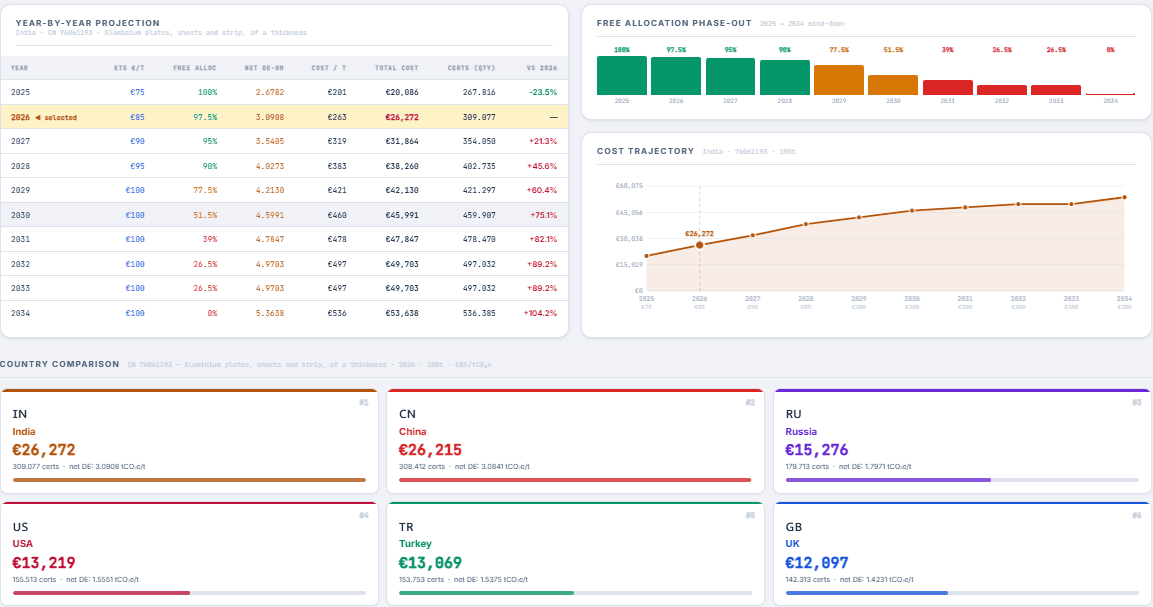
Source: CBAM Cost calculator (Regilient)
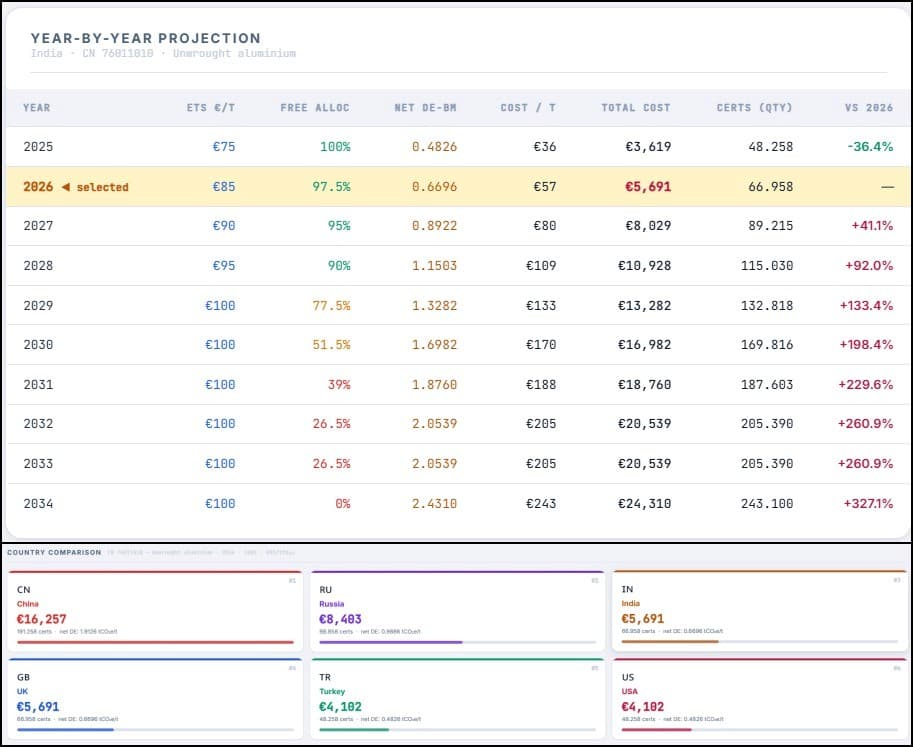
Source: CBAM Cost calculator (Regilient)
Fertilisers and Cement: High Pressure on Thin Margins
In the Fertiliser and Cement sectors, steady escalation threatens to erode thin profit margins and price competitiveness. Nitric acid fertilisers costs will rise from €12,432 to €26,130, while urea solutions will nearly triple to €9,620 per 100 tons by 2034. Similarly, in the cement industry, white Portland cement will see costs rise to €19,110, while the more carbon-intensive aluminous cement will climb from €15,469 to €29,770, making any additional carbon tax highly disruptive to international trade.
Ultimately, the data presents a stark reality that CBAM is not a static tariff but an aggressively compounding liability. For Indian corporations, the window between 2026 and 2034 represents a critical strategic period. To remain competitive in the European market, heavy industries must rapidly shift toward low-carbon technologies such as Electric Arc Furnaces for steel and renewable energy for aluminum, meanwhile establishing robust verification systems to avoid the financial penalty of relying on EU default values.
At Regilient, we understand the complexity of these obligations and are committed to supporting and managing your CBAM compliance requirements. Our expert team works alongside you to navigate regulatory requirements, optimize your reporting, and ensure seamless integration of CBAM obligations into your supply chain operations and transforming regulatory challenges into competitive advantages.