
Table of Contents
The European Union’s Carbon Border Adjustment Mechanism (CBAM) is fundamentally changing global trade. Designed to prevent "carbon leakage," CBAM ensures that carbon-intensive goods imported into the EU face a carbon price equivalent to what domestic producers pay under the EU Emissions Trading System (ETS).
The shift into the definitive phase of the EU CBAM on January 1, 2026, has sent shockwaves through the global industrial sector, transforming carbon intensity from a mere reporting metric into a direct, high-stakes cost of trade. Here is what your business needs to know to prepare, the steps you must take to comply, and how our automated platform will seamlessly guide you through this transition.
What Changes on January 1, 2026?
The transition to the definitive phase brings critical operational and financial shifts for anyone supplying or importing CBAM-covered goods (such as iron, steel, aluminium, cement, fertilisers, and hydrogen).
- Financial Liability Begins: Any covered goods cleared through customs from January 1, 2026, will be subject to CBAM costs. Importers will be required to purchase and surrender CBAM certificates based on the embedded emissions of their imports.
- Default Values Become Punitive: Currently, companies can rely on EU default values for reporting. In 2026, relying on default values will significantly inflate your CBAM costs, as these benchmarks are intentionally conservative and high. Actual, verified emissions data from suppliers will be required to mitigate this financial exposure.
- Strict Verification Requirements: To use actual emissions data, the information must be verified by an accredited third-party auditor, including an assessment against a strict 5% variance threshold.
- Annual Reporting: The quarterly reporting of the transitional phase will be replaced by an annual declaration submitted through the central EU CBAM Registry.
Who Does This Impact?
CBAM affects the entire supply chain, specifically:
- Importers (EU-based Declarants): You are legally responsible for compliance. You must collect actual emissions data from your global suppliers, calculate your CBAM cost exposure, submit declarations, and surrender certificates.
- Producers & Installations (Non-EU Exporters): While not directly regulated by the EU, your ability to sell into the EU depends entirely on your data. You must calculate installation-level emissions and provide verified data to your EU customers so they can avoid punitive default values.
- Traders & Intermediaries: Entities moving goods into the EU must ensure the flow of emissions data from the installation to the final importer.
The Compliance Process: A Step-by-Step Guide
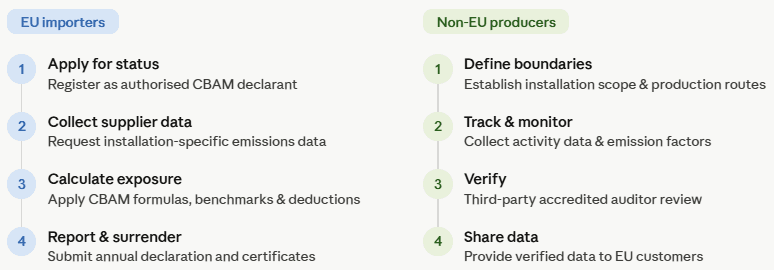
For EU Importers:
- Apply for Status: Register to become an "authorised CBAM declarant" to legally continue importing covered goods into the EU.
- Collect Supplier Data: Contact suppliers to request installation-specific, CBAM-compliant emissions data.
- Calculate Exposure: Apply CBAM formulas using the embedded emissions, EU benchmarks, phase-in rates, and any carbon price already paid abroad to determine your cost.
- Report & Surrender: Submit your annual CBAM declaration and surrender the required certificates via the EU Registry.
For Non-EU Producers:
- Define Boundaries: Establish exactly which installations, processes, and production routes fall within the scope of your exported products.
- Track & Monitor: Collect activity data and emission factors across each production stage, including data from your own upstream suppliers (precursor emissions).
- Verify: Undergo third-party verification for your emissions data and benchmarks.
- Share Data: Provide this verified, structured data to your EU customers to facilitate their compliance.
Why is CBAM Difficult to Manage?
Managing CBAM compliance manually through spreadsheets is no longer viable. Companies struggle with:
- Supplier Data Collection: Tracing emissions across multi-tiered, global supply chains is slow and highly manual.
- Data Quality Risks: If upstream data is inconsistent, formatted incorrectly, or fails verification, importers are forced to use expensive default values, removing cost control at the exact moment financial liability begins.
- Complex Methodologies: Calculating embedded emissions involves defining strict system boundaries, tracking precursor emissions, and distinguishing between complex production routes.
How Our Automated Solution Transforms CBAM Compliance?
To help you turn regulatory complexity into a competitive advantage, our CBAM Portal provides an end-to-end digital solution tailored for both importers and exporters.
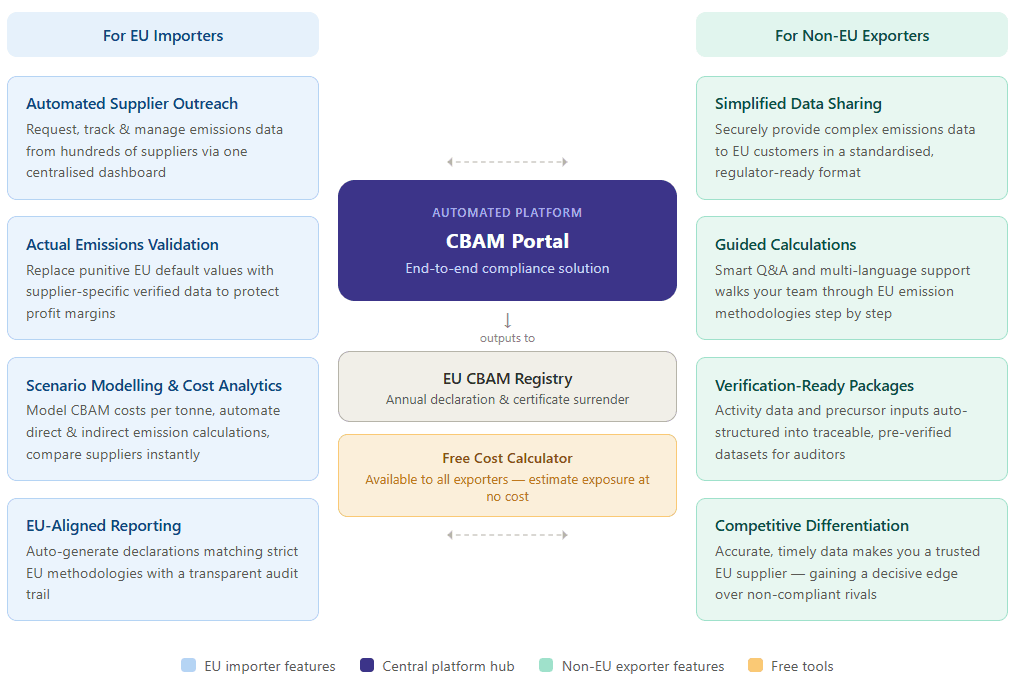
For Importers, our platform provides:
- Automated Supplier Outreach: Request, track, and manage CBAM data from hundreds of suppliers in one centralized dashboard—eliminating messy email chains.
- Actual Emissions Validation: We help you replace punitive default values with supplier-specific data, drastically reducing your CBAM cost exposure.
- Scenario Modelling & Cost Calculation: Instantly model your CBAM costs per tonne, automate calculations for direct and indirect emissions, and compare supplier efficiencies in seconds.
- EU-Aligned Reporting: Generate CBAM reports that perfectly match EU methodologies and templates, ensuring a clean audit trail for verification.
For Non-EU Exporters, our platform provides:
- Simplified Data Sharing: Securely provide your complex emissions data and documentation to your EU customers in a standardized format.
- Guided Calculations: Built-in smart questioning and multi-language support guide you through the EU's strict emission calculation methodologies.
- Verification-Ready Packages: Structure your raw activity data and precursor inputs into traceable, pre-verified datasets, reducing your audit risk and preventing last-minute firefighting.
- Competitive Differentiation: By providing accurate, timely, and well-organized emission values through our portal, you establish yourself as a trusted supplier, securing a distinct edge over competitors who cannot provide compliant data.
Don't wait until the financial penalties begin, whether you are an importer needing to shield your margins or a producer needing to protect your market access, our solution ensures you are fully prepared for the 2026 definitive phase.
At Regilient, we understand the complexity of these obligations and are committed to supporting and managing your CBAM compliance requirements. Our expert team works alongside you to navigate regulatory requirements, optimize your reporting, and ensure seamless integration of CBAM obligations into your supply chain operations and transforming regulatory challenges into competitive advantages.