
Table of Contents
You might think of Full Material Disclosure (FMD) as a compliance tool and you'd be right.
But it's also something else: a sustainability enabler.
- Want to reduce your carbon footprint?
- Design recyclable products?
- Meet ESG goals or support a circular economy strategy?
You can't do any of that without first answering one question:
*“What exactly is in our product?”*
And that’s what FMD answers — line by line, substance by substance.
Why ESG Needs FMD
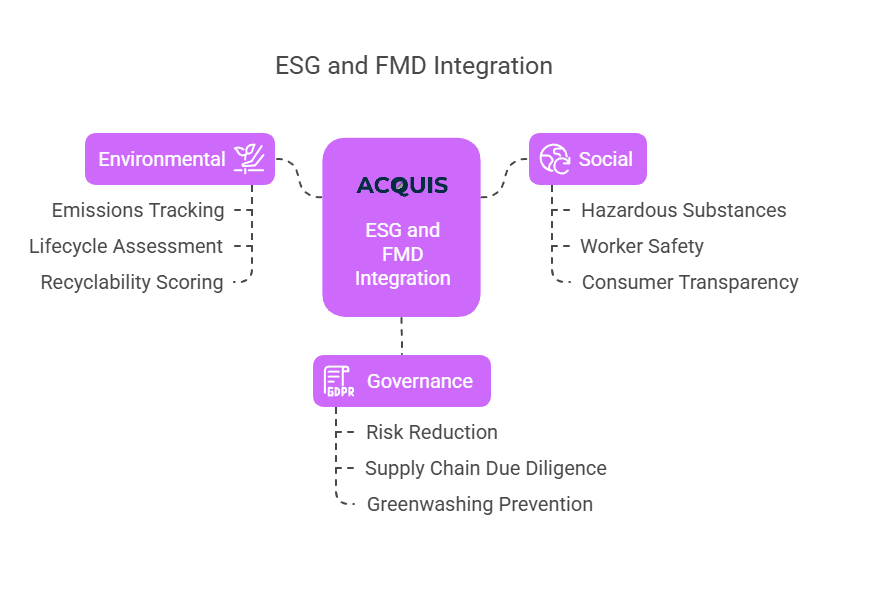
If your company is reporting on ESG metrics (or will be soon), FMD should already be on your radar. Here’s why:
Environmental (E)
You can’t manage your emissions, waste, or recyclability unless you know what materials and substances you’re working with.
FMD supports:
- Scope 3 carbon emissions tracking
- Lifecycle Assessment (LCA)
- Recyclability scoring
- Material scarcity & sourcing risk analysis
- Green design decisions at the R&D level
Social (S)
FMD helps ensure that the materials used in your products don’t come from unethical or unsafe sources.
Think:
- Hazardous substances exposure (Prop 65, TSCA, REACH)
- Worker safety during manufacturing
- Transparency for conscious consumers
Governance (G)
A structured FMD program helps reduce risk, ensure supply chain due diligence, and avoid greenwashing claims especially as ESG audits become more common.
Want to Report Carbon Footprint? You Need FMD First.
Let’s say you want to report the carbon footprint of a product.
You’ll need:
- The mass of each material in the product
- The type of material (e.g., recycled aluminum vs. virgin)
- The process used (e.g., casting, plating, coating)
- And the origin or supplier-specific emission factors (where possible)
*Part of ESG calculations starts with you guessed it Full Material Disclosure.*
No FMD?
You’re stuck estimating with generic database values. That’s like guessing your calorie intake from looking at your plate.
Digital Product Passports (DPP) Will Make FMD Mandatory
The EU’s Digital Product Passport (DPP) framework is coming fast — and it's going to change the way sustainability data moves through the supply chain.
DPPs will:
- Require material and substance-level transparency
- Be tied to regulatory frameworks (REACH, RoHS, Ecodesign)
- Support circular economy goals by informing recyclers and end-users
And at the center of it all?
*FMD.*
If you’re building products for the EU market, FMD won’t just be helpful it’ll be required.
Circular Design Starts With Material Knowledge
*You can’t design for reuse, recycling, or recovery if you don’t know:*
- Which substances might interfere with recyclability?
- Which materials are hazardous or restricted
- What’s actually feasible to separate at end of life
*FMD helps teams:*
- Avoid materials that create end-of-life disposal problems
- Design with recyclability in mind
- Choose sustainable, low-impact alternatives from the start
Final Word: FMD Is the DNA of Sustainable Product Strategy
*If ESG is the why, FMD is the how.*
You want transparency, traceability, and trust? You start with data. Full, accurate, material data.
Because you can’t improve what you can’t measure and you can’t measure what you don’t even know exists in your product.
Up Next: Preparing for Digital Product Passports — A Manufacturer’s FMD Checklist
In our next post, we’ll break down what companies need to do now to prepare for DPP rollout — and how a strong FMD program gives you a head start.