
Table of Contents
UK CBAM vs EU CBAM: Key Differences and What It Means for Global Industries.
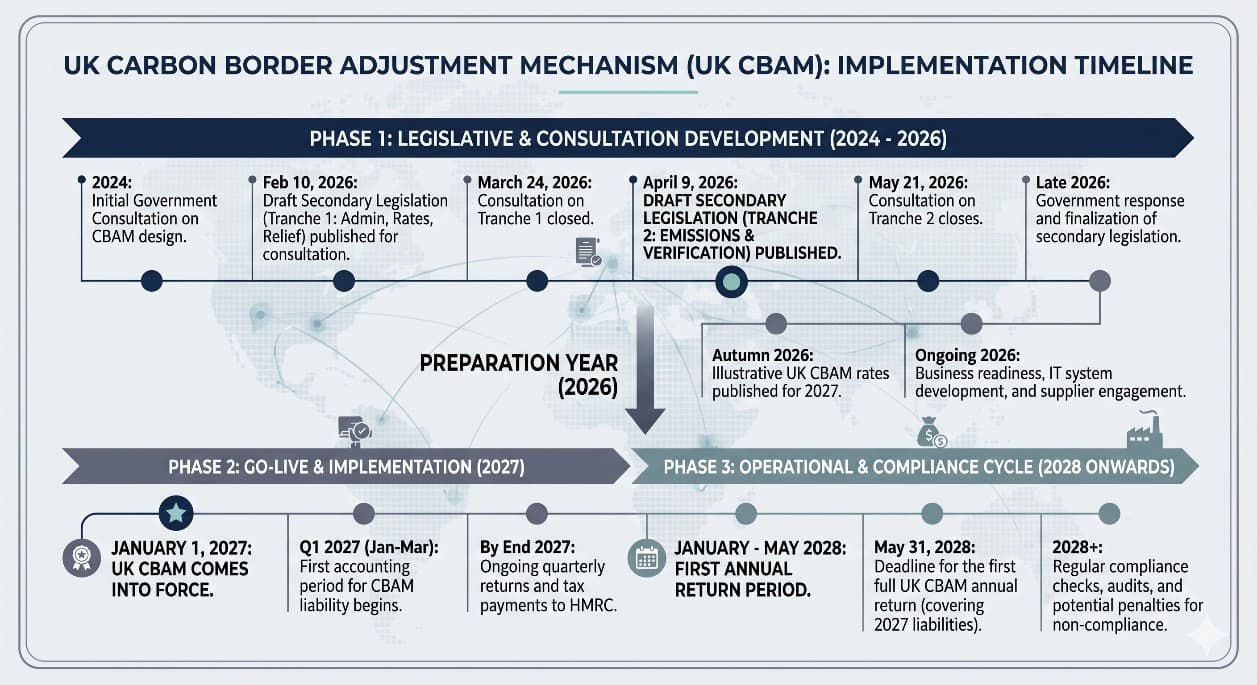
Following the publication of secondary legislation draft on April 9, 2026, the United Kingdom has solidified its own roadmap for a Carbon Border Adjustment Mechanism (CBAM). Scheduled for full implementation on January 1, 2027, the UK CBAM aims to level the playing field for domestic industries by ensuring that carbon-intensive imports bear a carbon price equivalent to that paid under the UK Emissions Trading Scheme (ETS).
Timeline of UK CBAM
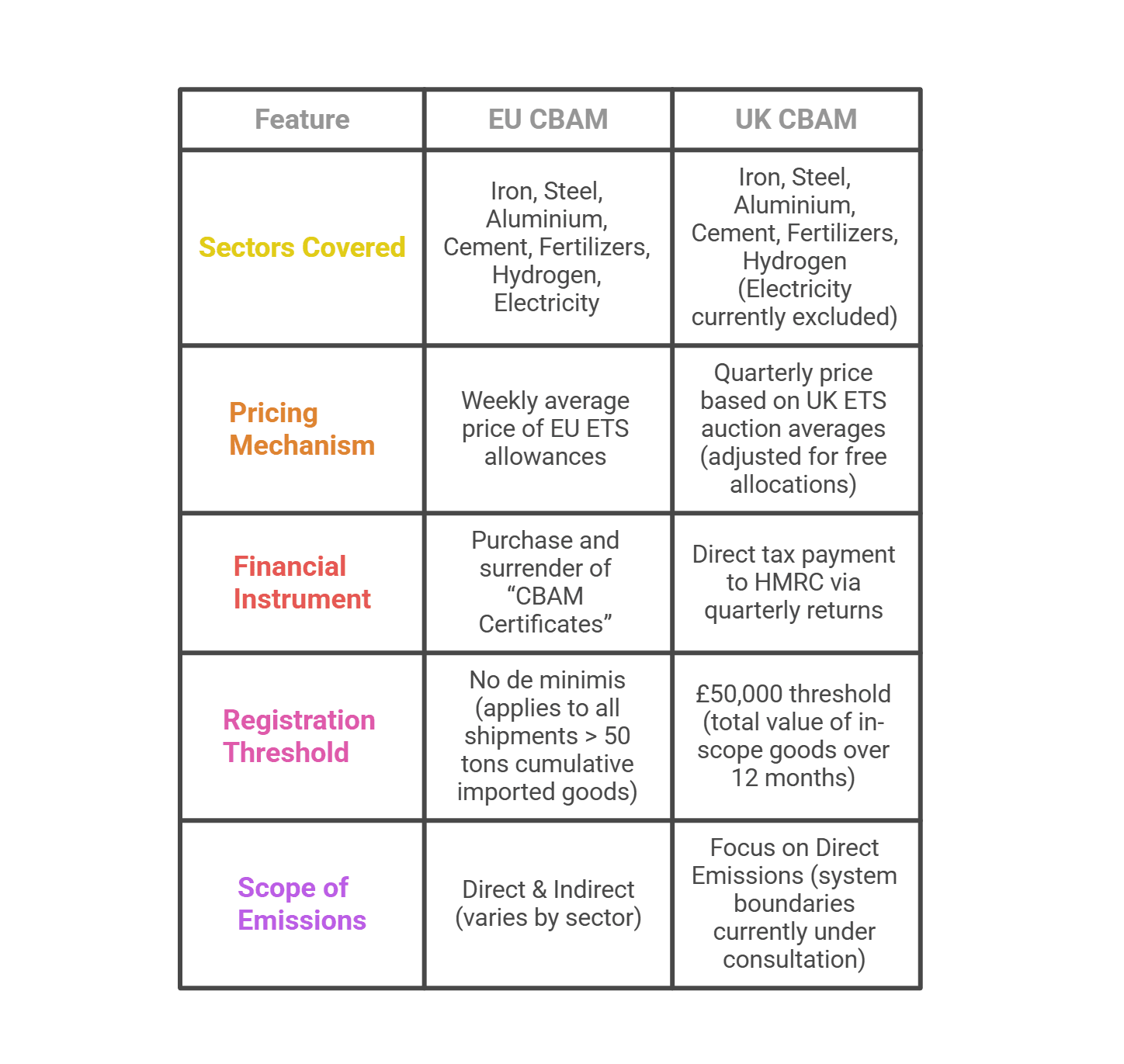
For global suppliers and UK-based importers already grappling with the EU’s CBAM regime, this development introduces a new layer of complexity and dual-track compliance environment. While both UK CBAM and EU CBAM mechanisms aim to prevent "carbon leakage," the UK's approach features distinct technical and administrative differences that will impact market strategy.
Critical Market Shifts: What to Expect after UK CBAM
The divergence between the two regimes suggests three major market trends:
- Bifurcation of Supply Chains: Suppliers may begin "segmenting" inventory. Low-carbon intensity batches might be diverted to the EU (where prices are historically higher), while standard-intensity products may target the UK or markets without CBAMs.
- The "Double Reporting" Burden: Overseas manufacturers must now maintain two sets of data. While the EU requires reporting based on "combined nomenclature" (CN) codes and specific thermal energy calculations, the UK’s draft legislation emphasizes a £50,000 value-based threshold for registration, shifting some focus from volume to valuation. Although UK is defining their emission calculation standards which is still needed to compare with defaults emission values of EU CBAM to look upon.
- Price Volatility Management: The UK’s quarterly rate-setting provides more short-term price certainty than the EU’s weekly fluctuations, allowing importers to hedge carbon costs more effectively in 3-month windows. As per the current prices, UK ETS is moving around €50 while EU ETS price is very dynamic and in range of around €75 - €85.
Impact of UK CBAM on Industries
The UK steel industry is currently facing a perfect storm of regulatory pressure and commercial vulnerability. Recent warnings from industrial giants like Tata Steel UK suggest a sector on the brink of collapse, while the European Union has firmly shut the door on UK exemptions from its own CBAM.
In early 2026, the EU’s refused to grant the UK an exemption from the EU CBAM. Despite the UK having its own ETS and a pending CBAM, the EU remains firm, Unless the UK formally links its UK ETS with the EU ETS, UK exports to Europe will be taxed. UK steel and aluminium exporters are being "double-taxed" by administrative complexity. They must pay the UK carbon price and then jump through rigorous EU reporting hoops to prove it, often facing "carbon price gaps" if the UK market price dips below the EU's.
As the UK prepares to launch its own CBAM on January 1, 2027, the market is entering a high-stakes transition period where policy and survival are in direct conflict. UK steelmakers pay significantly higher energy costs and carbon prices than global competitors. While the UK CBAM is designed to fix this by taxing "dirty" imports, the mechanism is still months away from implementation. Domestic producers are currently in the middle of expensive shifts from blast furnaces to Electric Arc Furnaces (EAF). This "green transition" requires immense capital; however, the lack of immediate protection from cheap, high-carbon imports are draining the cash reserves needed to complete these projects.
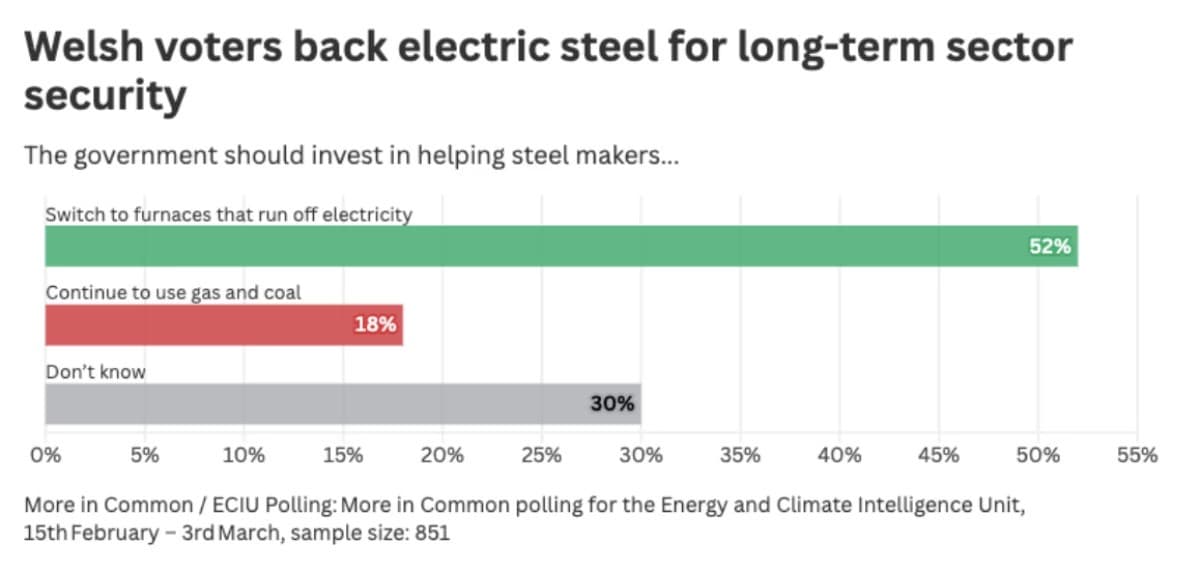
Source: Energy and climate intelligence Unit
The polling data from ECIU reveals that a substantial 52% majority of Welsh UK voters support government investment to help steelmakers switch to electric furnaces. In contrast, only 18% favor continuing with gas and coal, while 30% remain undecided. This strong public mandate for "green steel" is directly linked to the competitive pressures of the upcoming UK CBAM (launching Jan 1, 2027). To survive this regulatory environment, domestic steelmakers (such as Tata Steel UK) must accelerate expensive transitions from coal-fired blast furnaces to EAF to reduce their carbon footprint.
Stakeholder Perspectives: Case Studies
The Supplier’s Perspective
Scenario: An Indian Steel Manufacturer exporting to both EU and UK.
The supplier must provide "Actual Values" for emissions. However, the EU and UK defined "system boundaries" (what processes are included in the footprint) differently.
This will impact the suppliers’ technical and sustainability team to run dual-accounting. For the UK, they must track "Carbon Price Relief" (CPR) that is proving any carbon tax already paid in India to deduct it from the UK liability. If the documentation formats differ, administrative costs could rise by 15-20%. Strategy to tackle this is implementing a unified "Carbon ERP" (enterprise resource planning) system that can toggle between UK and EU reporting templates to minimize manual errors and audit risks.
The Importer’s Perspective
Scenario: A UK-based construction firm importing specialized Aluminium profiles.
Under the UK draft legislation, the importer is the liable person. Unlike the EU’s "Authorized CBAM Declarant" status, the UK utilizes the existing HMRC (HM Revenue and Customs) "Government Gateway" for tax returns. If the importer exceeds the £50,000 threshold of net import, they must register within 30 days. Failure to accurately report emissions from the overseas supplier results in penalties. If the supplier provides "Default Values" (which are typically penalized with a higher rate), the importer’s margin is directly squeezed.
Strategy to solve this problem should be rewritten of procurement contracts to include "Carbon Transparency Clauses," legally obligating suppliers to provide verified actual emissions data or compensate the importer for the higher tax cost of using default values.
The UK CBAM is not a carbon copy of the EU's policy. Its integration with HMRC as a direct tax, rather than a certificate-trading scheme, makes it a more rigid financial obligation for importers. For professionals in the compliance space, the priority is now data transparency, accounting and validations system, the ability to move carbon data across borders as fluidly as the goods themselves.
At Regilient, we understand the complexity of these obligations and are committed to supporting and managing your CBAM compliance requirements. Our expert team works alongside you to navigate regulatory requirements, optimize your reporting, and ensure seamless integration of CBAM obligations into your supply chain operations and transforming regulatory challenges into competitive advantages.
Book a 30-Minute Demo — Talk to Our Compliance Experts
References:
1. UK CBAM 2026: https://www.gov.uk/government/publications/carbon-border-adjustment-mechanism-cbam[…]-summary/carbon-border-adjustment-mechanism-cbam-policy-summary
2. ECIU Steelmakers behavior voting: https://mcusercontent.com/8ed7ad7972fae058e8f4fb7e8/files/9d6cc83a-e92c-bba5-1279-4061f295f0db/Wales_steel_polling_2026.pdf
3. UK CBAM Factsheet: https://www.gov.uk/government/publications/factsheet-carbon-border-adjustment-mechanism-cbam/factsheet-carbon-border-adjustment-mechanism
4. EU CBAM Guidance and legislation: https://taxation-customs.ec.europa.eu/carbon-border-adjustment-mechanism/cbam-legislation-and-guidance_en